Hahn/Cock – The Giant Blue Rooster of Minneapolis
If you visit Minneapolis as a tourist, you will probably make your way eventually to the Walker Art Center’s Sculpture Garden in search of the iconic Spoonbridge and Cherry. But while that sculpture may be the reason for your visit, it may not be the one on your mind when you leave.
It’s the giant blue rooster that will lodge itself permanently in your memory.
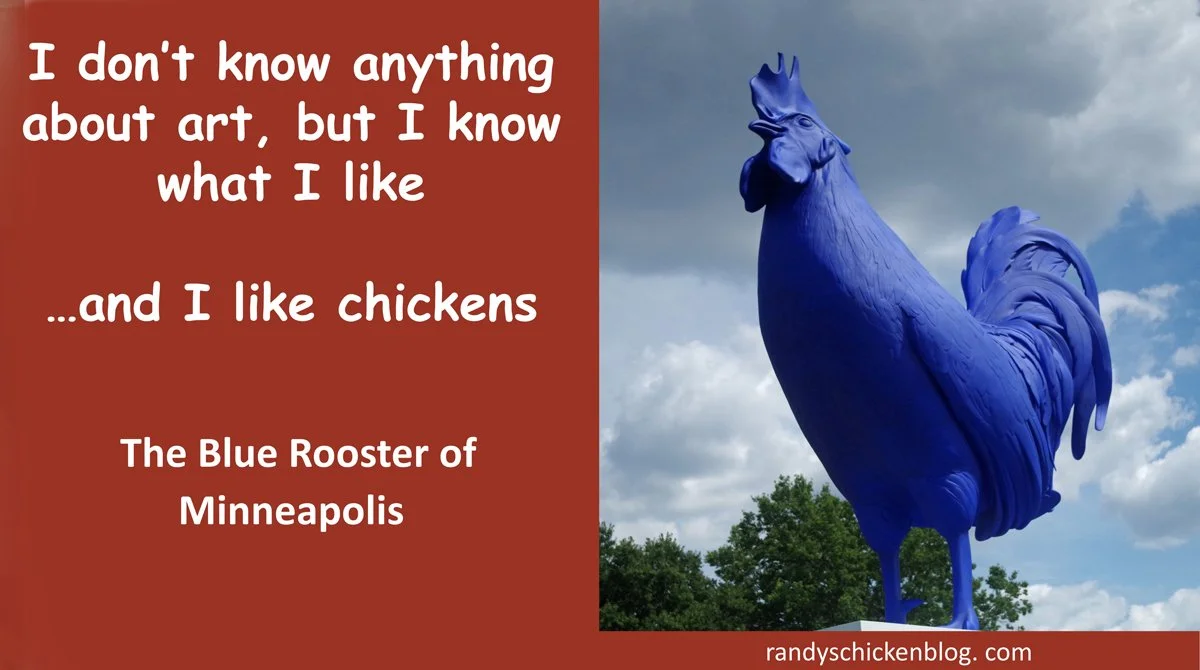
The big, audacious roo is impossible to miss, hard to forget, and is becoming an icon in its own right. And as a Minnesotan who writes about chickens, it’s probably long past time I said a few words about this oversized bird in our midst.
The 25-foot-tall blue fiberglass rooster standing on a steel base was installed in the sculpture garden in 2017 and is officially named Hahn/Cock. It was created by German artist Katharina Fristch.
Fristch is known for her use of scale, bold color, and—maybe most importantly—off-kilter whimsy and ironic humor. She is best known for Rattenkönig (Rat King), a nightmarish circle of enormous black polyester rats displayed at the 1999 Venice Biennale.
The Hahn/Cock on display in Minneapolis is her second iteration. The first made headlines when it appeared in London’s Trafalgar Square as part of the city’s “Fourth Plinth” project.
If you’re familiar with Trafalgar Square, a massive blue barnyard fowl is probably not the first thing that comes to mind. The square commemorates Britain’s naval victory over France at the Battle of Trafalgar, and nearly everything there radiates a swaggering, over-the-top masculinity. At its center stands Lord Horatio Nelson, hero of the battle, high atop a towering column. Surrounding him at the four corners of the square are four plinths (statue bases). Statues of kings and generals inhabit three of the plinths—George IV dressed as a Roman emperor on horseback, and Major General Sir Henry Havelock and General Sir Charles James Napier—military figures instrumental in the British conquest of India.
The Fourth Plinth was originally intended to hold a statue of William IV, but when funding ran out, it sat empty for 150 years. Eventually, London decided that the blank pedestal deserved attention. Contemporary artists were invited to place temporary works there, and Katharina Fritsch was asked to contribute.
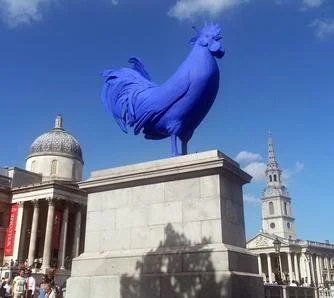
Hahn/Cock in Trafalgar Square - fair use
Her challenge was to design something that could hold its own amid all that stone, bronze, and 19th-century martial bravado. So…a giant blue rooster? Well, obviously!
Fritsch later claimed she didn’t initially realize that the rooster is the unofficial national symbol of France—until someone pointed it out. Once she knew, she happily embraced the irony. “It’s a nice humorous side-effect to have something French in a place that celebrates victory over Napoleon,” she said. “He has come back as a cockerel!”
Even if the French connection was an accident, Fristch was very much aiming for humor from the very beginning. “Humor is always a big thing for me,” she declared. “It stops things from becoming too severe.” She took note of the militaristic, male-dominated surroundings, and male statues on giant phallic columns, and decided that she would create her giant blue rooster as "a feminist sculpture, since it is I who am doing something active here – I, a woman, am depicting something male. Historically it has always been the other way around.” She also admitted that Hahn/Cock is a purposefully intended double entendre.
The London rooster, which was unveiled in 2013, no longer roosts in Trafalgar Square. Its permanent home is now at the National Gallery of Art in Washington, D.C. But Minnesota’s blue roo still perches proudly at the Walker, in all his ultramarine glory.
If you find yourself in Minneapolis, make a point of paying him a visit. And while you’re there—for the chicken—you can also take note of the Spoonbridge and Cherry.
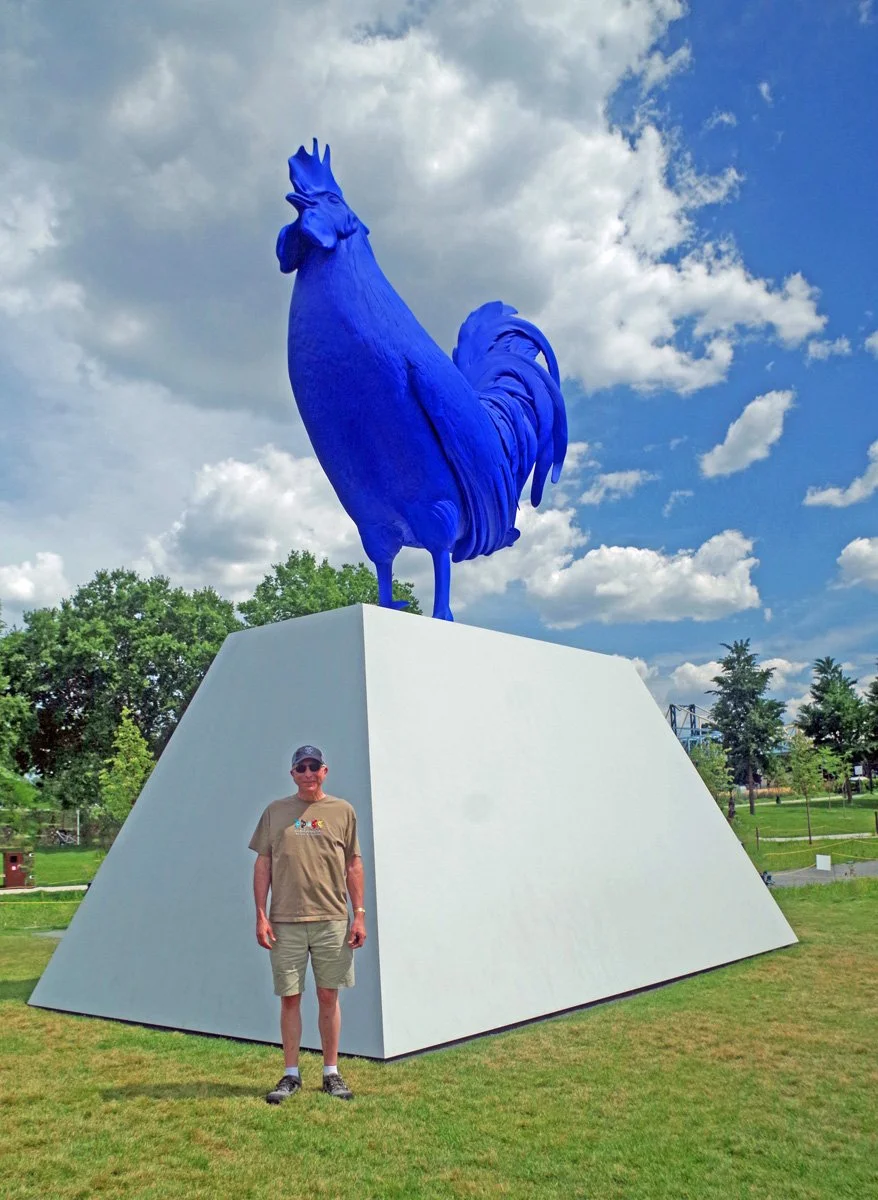
The author poses with the blue roo