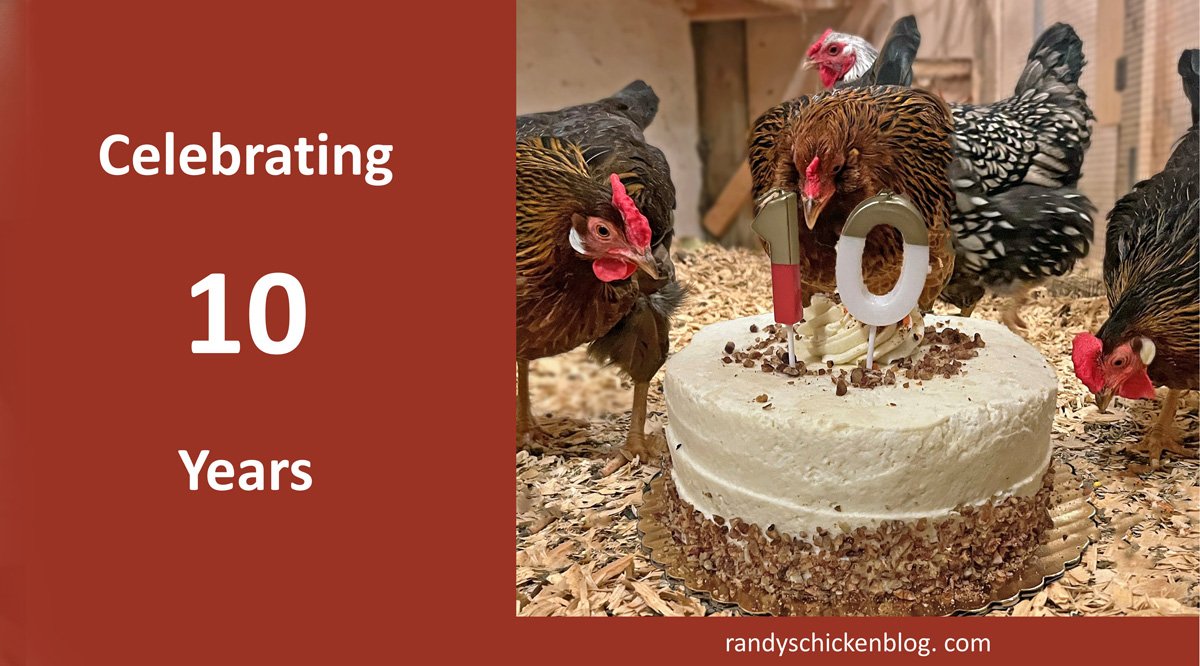
Randy's Chicken Blog: The Tenth Anniversary
Ten years ago, I started writing Randy’s Chicken Blog. Ten years! I’ve been doing this for ten years, folks. Who’d’ve thunk it? When I started this little endeavor, I didn’t spend much time imagining where it was going or how long I’d keep at it.
I also didn’t spend much time on the name. I’m Randy. It’s a blog. It’s about chickens. Insert blinding flash of inspiration here: Randy’s Chicken Blog. Wow.
It occurs to me I could have gone with something like Backyard Eggscapades, or maybe Fine Feathered Forum, or how about Chicken Chat Central, or—best yet—Some Fowl Words. These all came to me in the last few minutes as I sat here at my keyboard, inspired by nothing more than a little thought and some strong coffee. But nope. I went with Randy’s Chicken Blog, and after ten years, I guess that’s what it’s going to be. Those other, more inspired names are up for grabs, so feel free.
Before the blog, there were the chickens. The first little peepers arrived in 2013, as I was approaching retirement. By the time I started the blog in 2016, I’d already been writing about chickens for a while. But just on my personal Facebook page. Eventually it occurred to me that my Facebook friends might appreciate a little relief from my constant discourse about chicken stuff. My solution was the blog: I’d give my friends a break and go looking for an audience that actually cared about chickens.
Happily, I found that audience. All of you!
Over the course of a year this blog reaches tens of thousands of folks all over the world. I’m still amazed every time I check the numbers. And it’s been deeply satisfying to write about something I care about so much—and to know that enough of you care about it, too, to keep reading.
It would be really cool if everything I wrote was immensely popular, but that’s not how it works. There are articles that land with a thud and never get any traction. I’m not going to talk about those. Then there are articles I wrote seven or eight years ago that lots of people are still reading all the time. I will happily say a few words about some of those.
Here are the five all-time top articles from Randy’s Chicken Blog. All of them have been around for a while, and readers continue to find and read them!
-5-
Why is Marissa’s Belly So Bloated?
Recognizing and Dealing with Ascites in Hens
2019
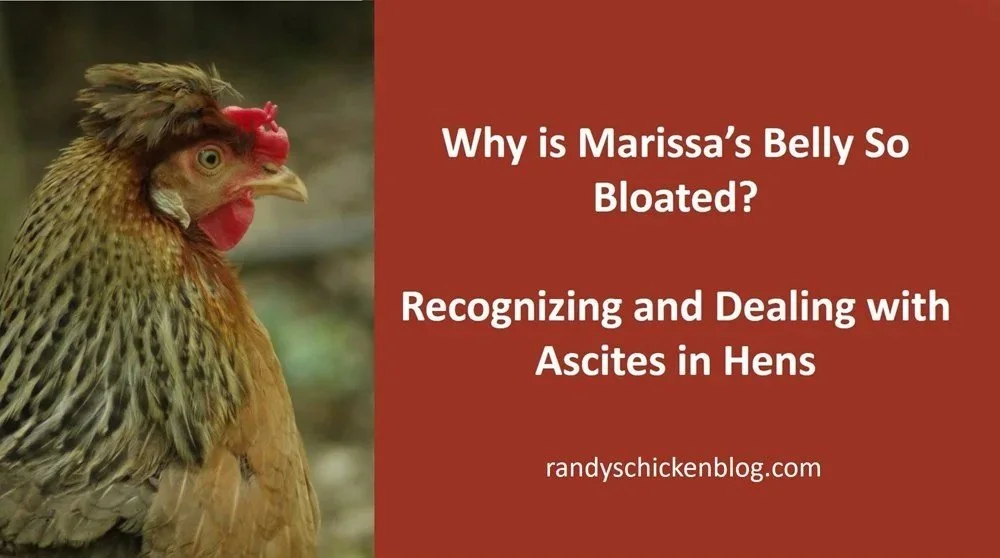
Something was wrong with Marissa the Cream Legbar! Her belly was blown up like an over-inflated basketball, she had lost interest in all the usual chicken activities and she spent all of her time standing in a quiet corner looking sad.
In Why is Marissa’s Belly So Bloated?, I outline how I worked through the differential diagnosis and concluded that this poor girl was suffering from ascites. Then I describe her treatment, including visits to my local, friendly vet, but also at-home paracentesis—removing the excess fluid from her abdomen with a needle and syringe.
Marissa was profoundly sick for two years and under continuous treatment. But here’s the best news: she eventually went into remission. Today, she’s still happily hanging out with the other hens in the barn. She turns ten this spring. It’s so fitting that I’m talking about Marissa first—she’s the same age as the blog!
-4-
Marek’s Disease
Six Things You Should Know
2018
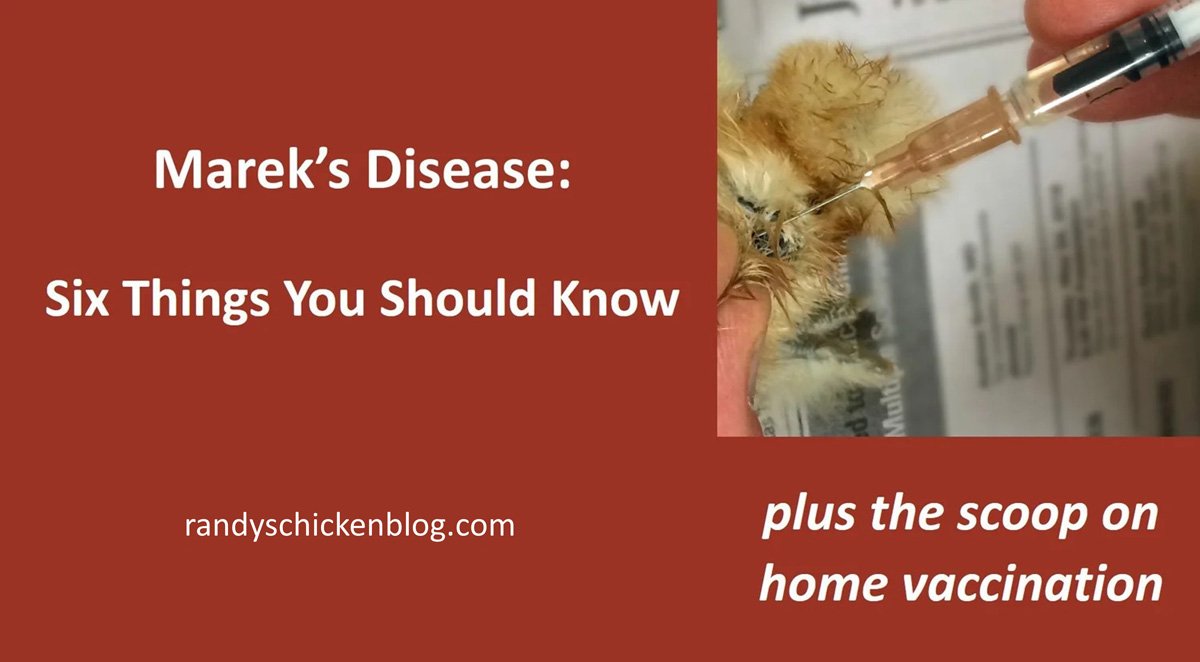
If Marek’s Disease strikes your flock there’s very little you can do except suffer as your sick chickens suffer, and end their suffering when it becomes severe. There is no cure. Your only good strategy is to prevent Marek’s from harming your flock in the first place. And the simplest method of prevention is to vaccinate chicks as soon as they hatch or to buy chicks that are already vaccinated.
Marek’s Disease - Six Things You Should Know covers the symptoms, pathology, and prevention strategies for Marek’s, including home vaccination. It’s a long post, is somewhat technical, and deals with a depressing, widespread, fatal disease. It is not light reading.
Yet, it was popular out of the gate. Because there are a lot of flock keepers searching for information. Most likely because their birds have acquired this devastating disease and are suffering and dying.
In 2021, I updated and expanded the information in this article in Marek’s Disease: 8 Questions - 8 Answers. Both posts continue to get a lot of traffic.
-3-
What’s Killing Our Backyard Chickens?
The Top Six Causes of Death in the Backyard Coop
2020
Why do chickens die? When the angel of death visits your coop, what form will it take? Okay, this sounds a little dark, but it’s actually a pretty important question. If we can figure out the main causes of death in our coops, we can start working on solutions and give the feathered inhabitants of our backyards longer, healthier lives.
But until recently, nobody bothered to ask. Why? Because commercial chickens don’t have an opportunity to live to the end of their natural lives. The main cause of death of most chickens is the slaughterhouse. Layers usually last a couple of years and broilers are slaughtered when they are weeks old—still babies.
And then came the backyard chicken revolution. The chickens out there in our backyard coops usually live their full, normal lives until they die of natural causes. With this paradigm shift has come the need and desire to know what those “natural causes” are.
Eventually, researchers started looking at the statistics. The best, largest, and most comprehensive study looked at nearly three thousand birds from eight states over a period of three years. The results of that study were published in the Journal of Veterinary Diagnostic Investigation in 2019. It is important information but is a bit vet-jargony.
In 2020, I condensed the main points from that scientific article and translated into language that the average backyard chicken keeper could appreciate in What’s Killing Our Backyard Chickens. The main takeaway? Our birds are mostly dying from infectious diseases.
So now that we have that information, how can we put it to use? By preventing infectious diseases, obviously! I suggested ways of doing that in a follow-up article, Preventing the Preventable.
-2-
Rooster Spurs
And How to Trim Them
2024
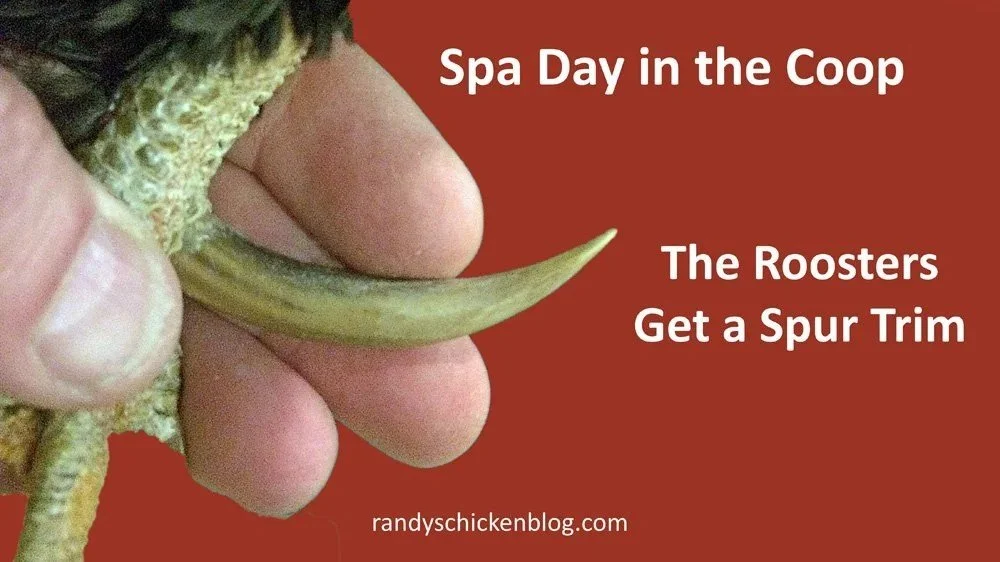
There was that day in 2016 when I noticed that one of Emile the Rooster’s spurs was growing so curved that it was almost winding back into his leg. Spurs can indeed sometimes grow all the way back into a rooster’s leg, causing pain and lameness. I instantly knew that Emile needed a trim—before that spur grew any more. And I decided that we would take care of all the guys while we were at it.
So, we had a spa evening in the coop and all three roosters—Emile, Paul and Snowball got manicures. I shot some pictures of the event.
A few yeas later, in 2024, when we had another spur-trimming evening, my daughter was on hand and took a bunch of pictures. The pictures from those two spur trimming sessions became the basis for Rooster Spurs and How to Trim Them.
In this article, I’ve put together some good, basic information on why you should trim spurs, and how you should do it—I also mention a barbaric method that you should not use.
There are apparently a lot of folks looking for spur trimming how-to’s and info—“Rooster Spurs” quickly rose to the status of the most viewed article on my site shortly after I posted it, and has stayed on top ever since!
-1-
Are Chickens Dinosaurs?
2018
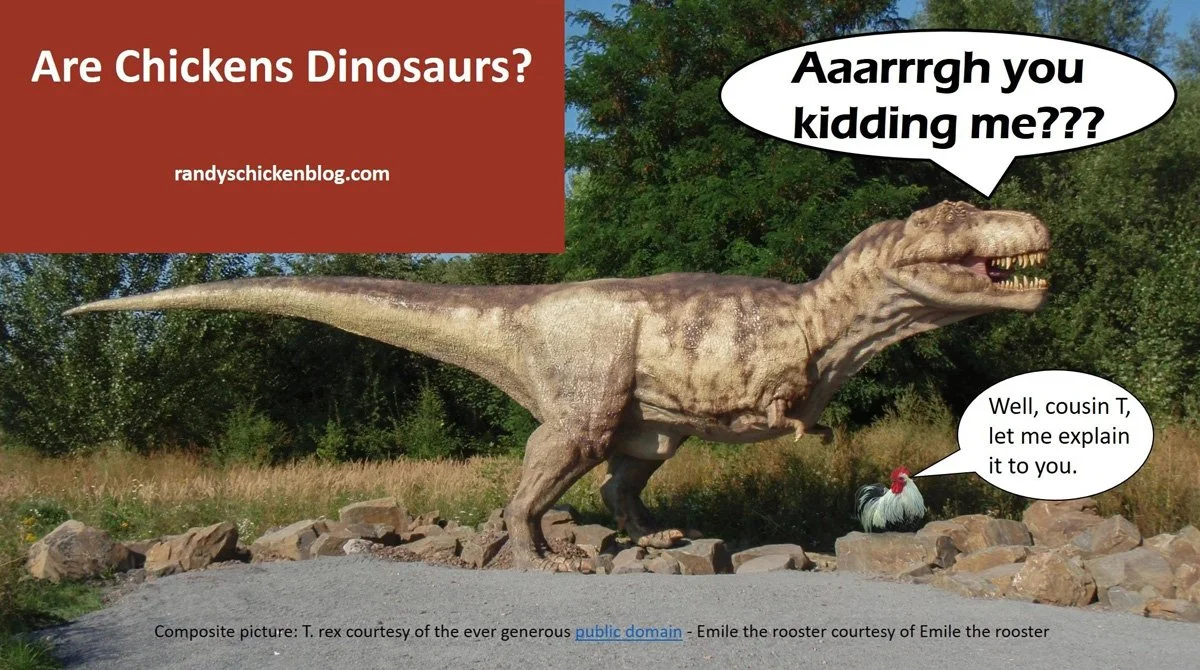
“Are chickens directly descended from T. rex? Isn’t it true that they’re the closest living relative to T. rex? Because Tyrannosaurus rex was really, like, a big chicken, right? And so, chickens are pretty much just dinosaurs, right?”
You’ve probably run into the chicken/dino question. Everybody has. If we turn to the great, wise internet for answers to those questions, it’s quite possible that we’ll wind up on a site that gives bad/wrong information.
After a lot of research and reading, I wrote my chicken/dino article in 2018. Are Chickens Dinosaurs is short and to the point and explains that practically every expert in the field has concluded that chickens really are dinosaurs—as are all birds. And, nope, chickens are not the closest living relative to T. rex.
This article has garnered a lot of traffic, has been linked here and there, and has generated its share of correspondence, comments and questions. One of my favorite comments from a skeptic: “I'd appreciate some kind of source or reference as to where you got the information that chickens are dinosaurs. Like, did you hear it from your Uncle Joey?”
The truth is, for anybody else who is wondering, I don’t post a bibliography with my articles, but I would happily provide one to anyone who asks.
For example, one reference for my declaration that all birds are dinosaurs is the 1997 book, The Mistaken Extinction: Dinosaur Evolution and the Origin of Bird by paleontologists Lowell Dingus and Timothy Rowe. Within the pages of this book the authors succinctly state that “…birds are avialian, maniraptoran, coelurosaurian, tetanurine, theropod, saurischian dinosaurs.”
You don’t need to look up all those twenty-five-dollar words. The important words in that sentence are the first two and the last. Most scientists are now firmly on the same page regarding the bird/dinosaur connection. There is still the odd dissenting scientist, but those who subscribe to the bird-dinosaur link are a pretty impressive bunch. As a group, they have more degrees than a thermometer. A really big thermometer!
My conclusion that chickens are not the closest living relative of T. rex is a little more complicated. I wrote two follow-up pieces in 2024 just to answer that single question. Are Chickens the Closest Living Relative of T. Rex? No! And Here’s Why They Are Not and Are Chickens the Closest Living Relative of T. rex? No! And Here's Where That Rumor Started are each much longer than the original chicken/dino article but both continue to generate a lot of pageviews.
True confession: All the dino stuff is only peripherally about chickens. And this is supposed to be a chicken blog. But I found it to be a pretty interesting rabbit hole, and the pageview numbers indicate that other people do too. And, come on—it’s dinosaurs!