Molting: Why Your Hens Do It and How You Can Help Them
Megan rushes from the coop to the house, grabs her phone from the kitchen counter and frantically taps a message to the local chicken forum, “Help! My hen is stretched out on the ground and having convulsions! What’s wrong?? Is she dying???”
Within the hour there are replies from a few seasoned chicken keepers. Minh, who’s kept chickens for twenty years; Linda, whose backyard flock seems to be a never-ending source of poultry wisdom; and Faye, who knows more than a little about the strange things chickens can do. All offer some soothing words. All are kind. All are patient. And, most importantly, nobody laughs.
Minh: “Your hen is okay, Megan. She’s dust bathing.”
Linda: “Dust bathing is perfectly normal and natural chicken behavior. When they roll on their sides, kick their feet, and roll around in the dirt it looks like they’re having seizures. But they’re actually enjoying themselves.”
Faye: “It’s how they keep their feathers clean and free of external parasites.”
Megan is relieved. Her hen is not dying! A dust bath. Who knew?!
A few weeks later, Megan is back on the forum. “Help! All my hens have stopped laying eggs and their feathers are falling off! What’s wrong?? Are they dying???”
The stalwart veterans soon respond.
Minh: “Your hens are okay, Megan. They’re probably molting.”
Linda: “Molting is normal and natural this time of year. Your hens are dropping their old feathers and growing new ones.”
Faye: “Your hens are using a lot of their energy and protein to grow those new feathers. They’re gonna stop laying eggs for a while.”
Once again, Megan breathes. Once again, she’s learned something new about her flock.
And once again, all the old timers who read the post feel a mixture of sympathy, amusement, and affection for the chicken newbie. They remember what it was like to be new to chickens—to discover that these strange little creatures have an entire inventory of behaviors that look terrifying to the uninitiated.
You and I are undoubtedly right there with Minh, Linda and Faye. Molting is something we take for granted. Molting happens—every hen molts!
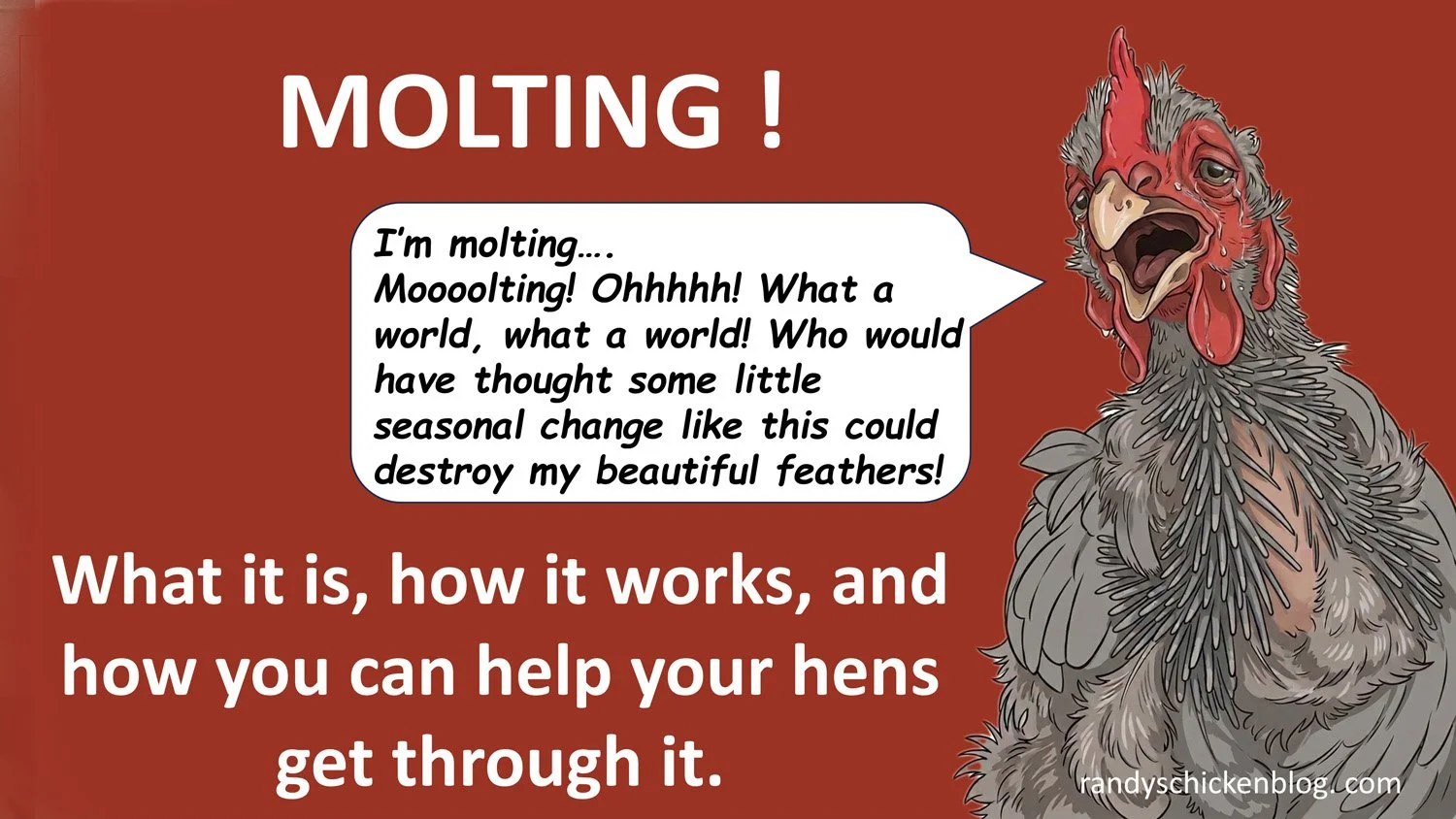
But maybe we all should take a step back and wonder about it. When you look at it with the fresh eyes of a new flock keeper it’s actually a pretty strange phenomenon. Why do chickens molt? What’s the point of losing all those feathers just so they can replace them with more feathers? What causes it? How does it impact your hens? What can you do to help them through the process? After a bit of research, here’s my scoop on molting.
Insides and Outsides
Let’s start with this basic fact: You and I, our chickens, and all animals have an inside and an outside. The outside layer is the part that separates and protects our insides from the world that we live in and that surrounds us. Outsides are made of a variety of different material depending on the animal: skin, scales, hair, feathers, cuticle, exoskeleton, etc. In all cases the outside layer is dead tissue. But it is made of tissue that was produced by or created from tissue that was once living.
This outer protective layer of dead tissue is subject to damage from all the slings and arrows of the world that surrounds all of us. As it becomes damaged, it can’t heal because it’s dead. So, to keep an intact, functional outer protective layer, the old dead tissue constantly comes off and is replaced by new tissue from underneath. It’s a pretty nifty design. Imagine if our cars worked like that. A constantly renewing car body. No scratches, dings or rust!
Everybody Molts!
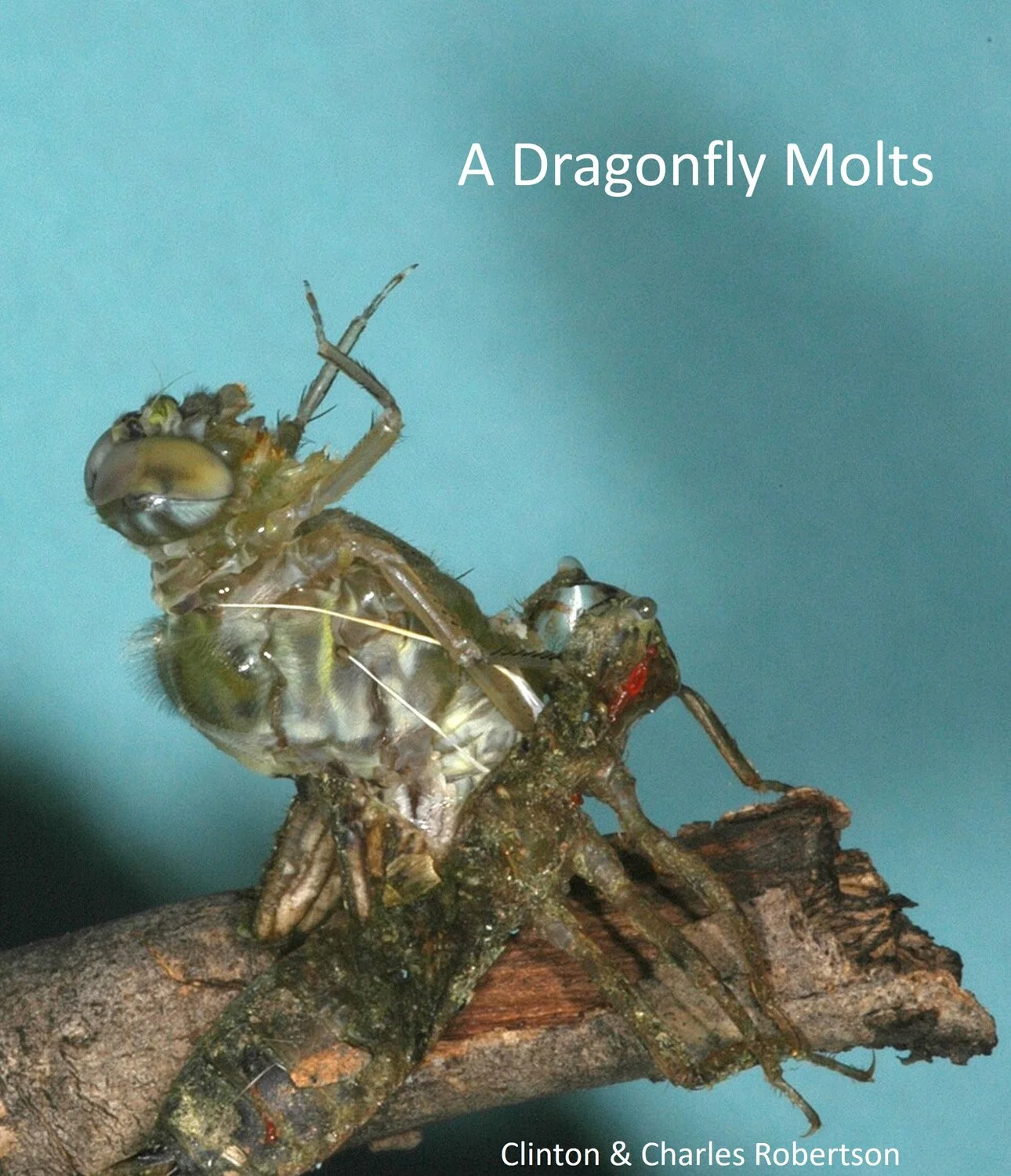
Actually, the sloughing off of the outer layer of dead tissue is not called “molting” for all animals. But you get my point, right? The same phenomenon of replacing the outside layer of tissue with new tissue from underneath occurs across all animal species.
Insects and other invertebrates with hard exoskeletons have to shed their entire outside because their insides outgrow it. The process is called ecdysis—the entire outside comes off in one piece, still retaining the shape of the animal that shed it.
Snakes also shed their outer layer in one piece. As the old skin dries and becomes brittle, the snake eventually crawls right out of it. Shedding can be a stressful time for a snake. Before shedding, the layer covering its eyes becomes cloudy and opaque, causing temporary blindness.
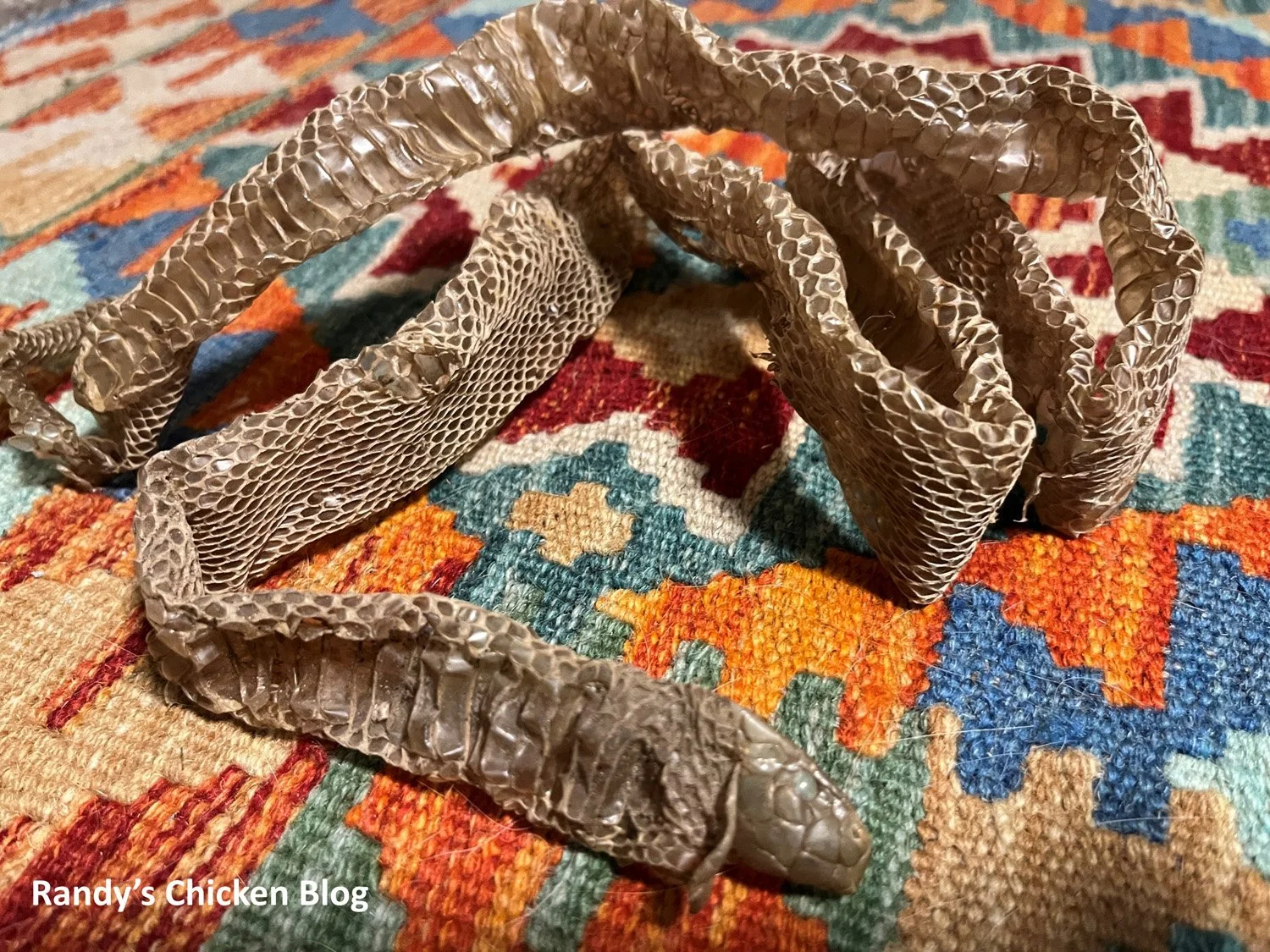
A shed skin from Elmer the Bull Snake who used to live in my garden shed.
We humans, fortunately, don't have to crawl out of our skin—or worry about becoming blind due to dead skin over our eyeballs. Our version of molting is gradual and continuous. We constantly lose skin cells and hair. In fact, we shed more than 30,000 skin cells every minute—amounting to roughly nine pounds of skin each year. Those cells fall off everywhere: in our beds, on our chairs, in our clothes, and behind us as we walk down the street. Studies have shown that dead human skin cells make up a significant component of household dust.
If you have pets, you're familiar with mammals shedding hair and dander. And if you have chickens, you certainly know about birds dropping feathers.
Different bird species molt in different ways. Some molt twice each year and may have different feather colors depending on the season. Other species lose feathers so dramatically that they temporarily lose the ability to fly. Waterfowl like ducks, geese and swans, for instance, become flightless for several weeks during their molt. Although they normally rely on flight to escape danger, they can still take refuge in open water while their new feathers grow in.
Birds of prey, such as hawks and eagles, shed and replace their feathers much more slowly. They typically molt gradually and symmetrically over several months, ensuring that they always retain enough flight feathers to stay airborne and hunt.
Chickens also molt, usually once a year in the fall as the days grow shorter. The speed and severity of the molt can vary considerably from breed to breed—and even from one chicken to another.
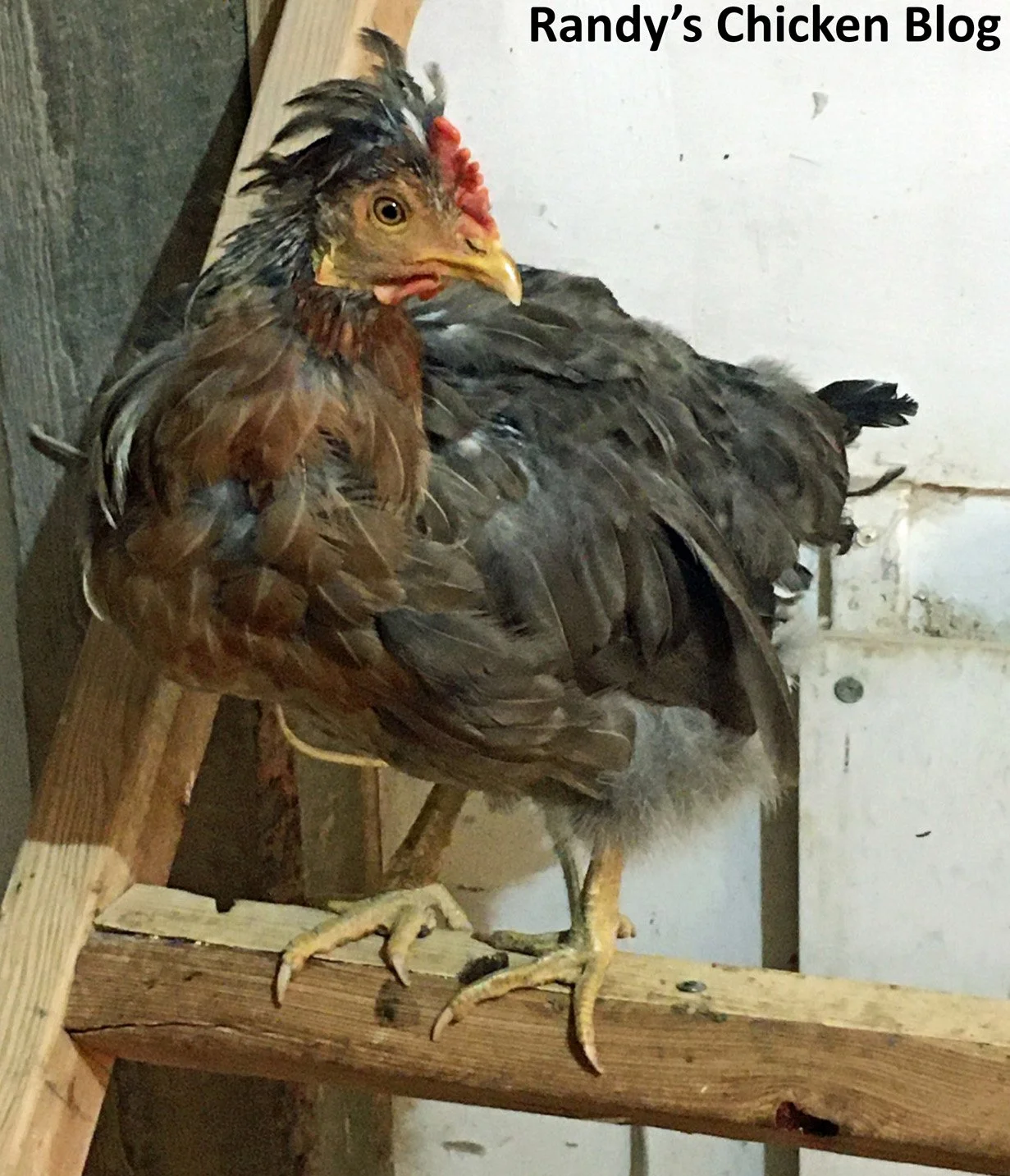
Marissa the Cream Legbar molts
Chicks Drop Down – The Juvenile Molts
The molting process begins even before a baby chick hatches. When chicks emerge from the egg, they are covered in natal down—the soft, fluffy covering that makes them so amazingly cute. But while they are still inside the egg, their feather follicles are already busy building their first real feathers.
When the chick is less than a week old, the natal down begins to fall away and the first true feathers—the juvenal feathers—start to emerge. These feathers appear first on the wings and tail and then gradually cover the rest of the body. By about one month of age, the chick has lost all of its natal down and is fully feathered.
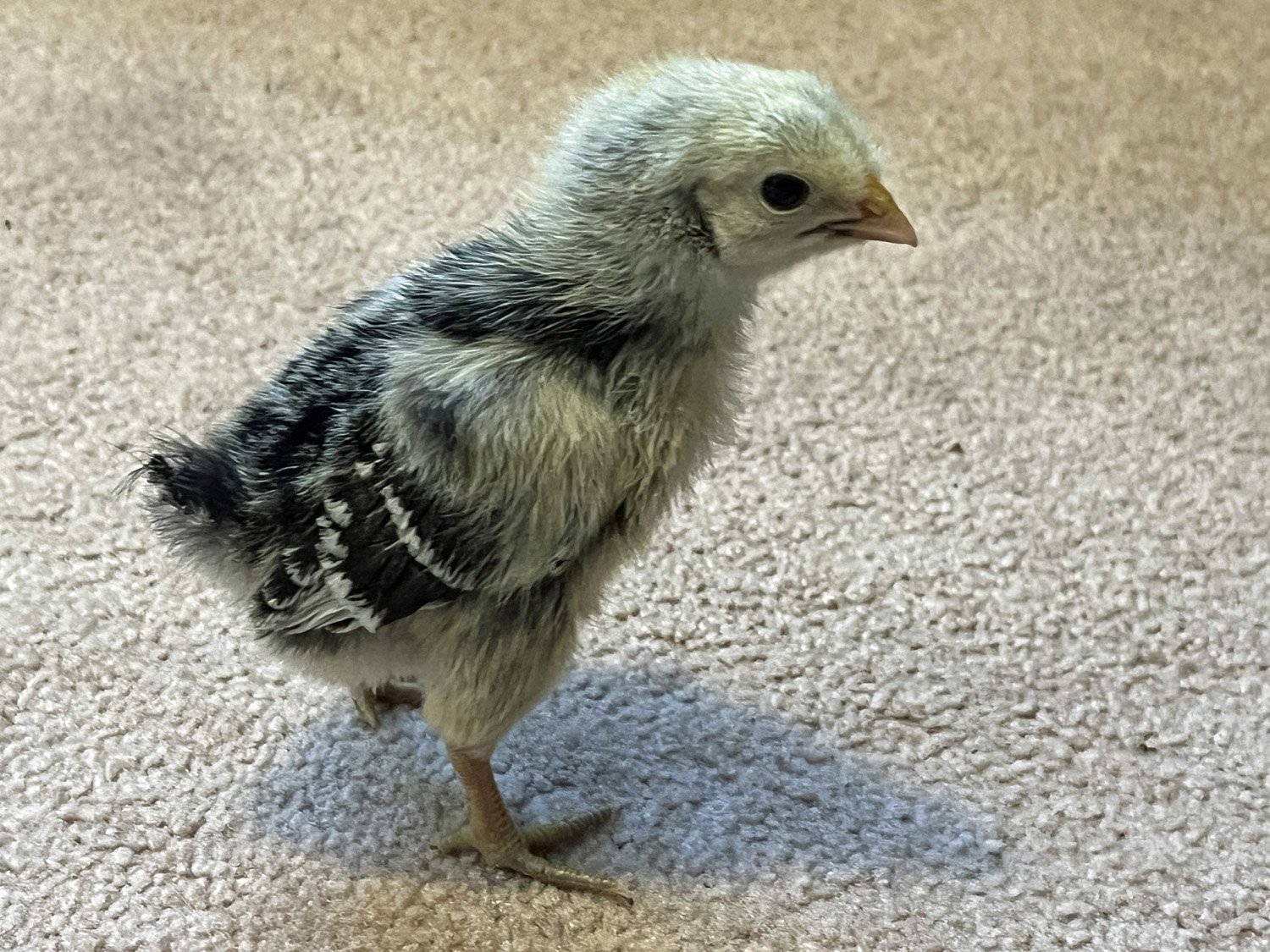
Elsie the Silver Spangled Hamburg, four days post-hatch, has already sprouted little wing feathers.
A few weeks later, those first juvenal feathers begin to fall out and are replaced by another generation of feathers—the second juvenal molt. The resulting third plumage displays the feather color and pattern that the chicken will have for the rest of its life.
This second molt is usually complete by the time the young chicken is about three months old. At that point, the juvenile feather-growing process is finished. The chicken will keep this set of feathers until its first adult molt, which happens a little over a year later.
Chickens Molt Annually
The fall molt that all adult chickens go through annually is triggered by decreasing daylight hours. The shorter days shut down an intricate system of hormonal signals and feedback loops called the HPG (Hypothalamic-Pituitary-Gonadal) axis and initiates the HPT (Hypothalamic-Pituitary-Thyroid) axis. The interplay between the HPG/HPT axes are not just responsible for the annual molt. These hormonal feed-back systems also control egg laying, sexual development and maturation, behavior, physiology, and even immune function. If you would a deeper dip into the functioning of the HPG axis, take a look at my piece on broodiness in hens “Why is My Hen Broody? And How Do I Make Her Stop?” where I plunge into the depths of Henrietta’s endocrine system to explore this phenomenon.
The Cliff’s Notes version of this complex biological system: The days get shorter. That triggers a hormonal cascade that causes the molt, shuts down egg laying, and initiates a period rejuvenation throughout the hen’s body. That’s it. It’s that simple.
While the dropping and replacing of feathers is so blatantly obvious it is impossible to miss, other more subtle changes are happening inside the hen. While she is shedding feathers, she’s also shedding her oviduct lining. When she begins laying again, her refurbished reproductive tract is prepared to produce better eggs with stronger shells. Her lymphatic tissues also undergo renewal, helping restore her immune defenses. Constant eggshell production during the laying season draws calcium from the hen’s bones, so the molt provides an opportunity for those calcium stores to be replenished and her bones to regain strength.
Her body also restores fat, protein, and pigment during the molt. During the laying season, the yellow pigment xanthophyll is diverted from the hen’s tissues into her eggs to color the yolk. After molting, a hen’s skin may be noticeably yellower because she has replenished her supply of that pigment.
The process of body rejuvenation and feather replacement can take anywhere from two to four months, depending on the breed, age, and the individual chicken. Some hens go through a hard molt, dropping most of their feathers at once and developing huge bald patches. Other hens molt so gradually that the process is hardly noticeable.
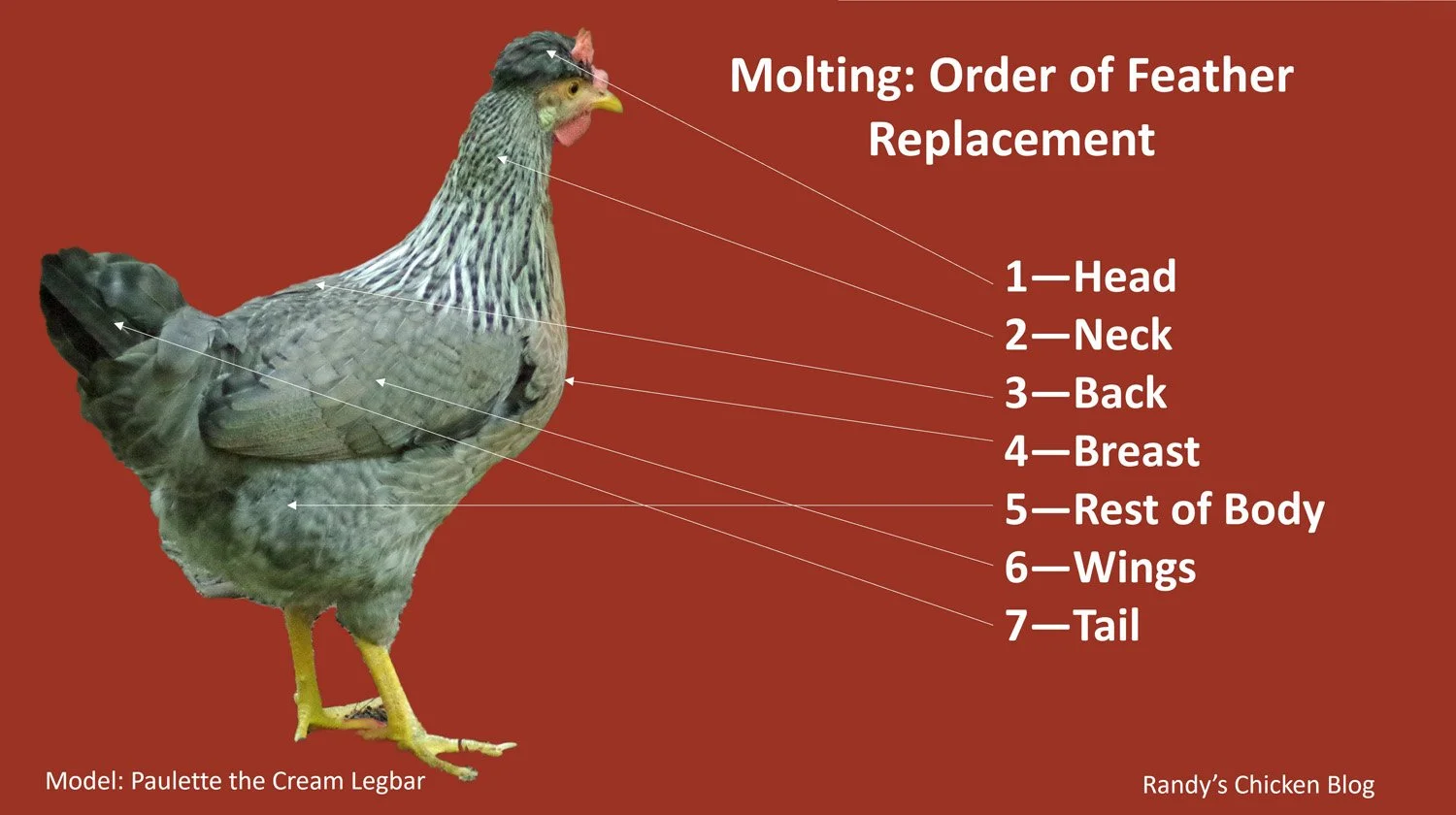
Feather replacement follows a specific sequence. It starts with the head, then moves down the neck to the chest, back, and wings. The wing feathers have their own sequence. The first to fall are the primary flight feathers, beginning with the primaries in the center of the wing and progressing toward the tip. The secondary flight feathers don’t fall until the primaries have completed their molt.
The coverts—the small feathers that overlap the flight feathers on top of the wing—are part of the general body plumage. They drop along with the feathers on the neck and back, so they may molt along with, or even before, the wing’s flight feathers.
The last part of the chicken to molt is also the last part of the chicken to go over the fence: the tail feathers. When the tail feathers have been replaced, the molt is complete.
Chickens need protein and energy to make new feathers—two things they also need to produce eggs. And hens stop laying eggs while they’re molting. So, it’s a common misconception that molting stops egg production: Henrietta jumps off the roost one morning, looks in the mirror, notices a bunch of missing feathers, and exclaims, “Jeepers! I’ve gotta make feathers! No more egg laying for me for a bit!” But nope. That’s not how it works.
Feather production does not cause hens to stop laying eggs. The waning-light-induced hormonal cascade causes hens to molt. That same hormonal cascade also causes ovulation to cease. One does not cause the other. The two things happen simultaneously because they are triggered by the same catalyst: decreasing daylight.
The Life of a Feather
Feathers are made of keratin, the same tough fibrous protein found in our fingernails and hair, as well as in the hooves and horns of other animals. Feathers are produced by and anchored in feather follicles within a chicken’s skin. Feather follicles are similar to the hair follicles that produce and anchor hair in humans and other mammals. But while a strand of hair is fairly simple, there’s nothing simple about a feather.
The base of a typical feather is large, hollow, and called the quill. Those old-fashioned writing quills were actual feathers dipped in ink—the ink filled and would flow out of the hollow center as the quill moved across the paper. The quill is also the part of the feather that fits into the feather follicle in the bird’s skin and anchors the feather to the chicken. Above the quill, the feather shaft narrows. This portion of the shaft is called the rachis.
Coming off the rachis is the feather’s vane—the broad, flat part that gives a feather its familiar shape. The vane is made up of small strands branching from the rachis called barbs. Even finer strands, called barbules, branch from the barbs. And branching from the barbules are tiny hooks called barbicels.
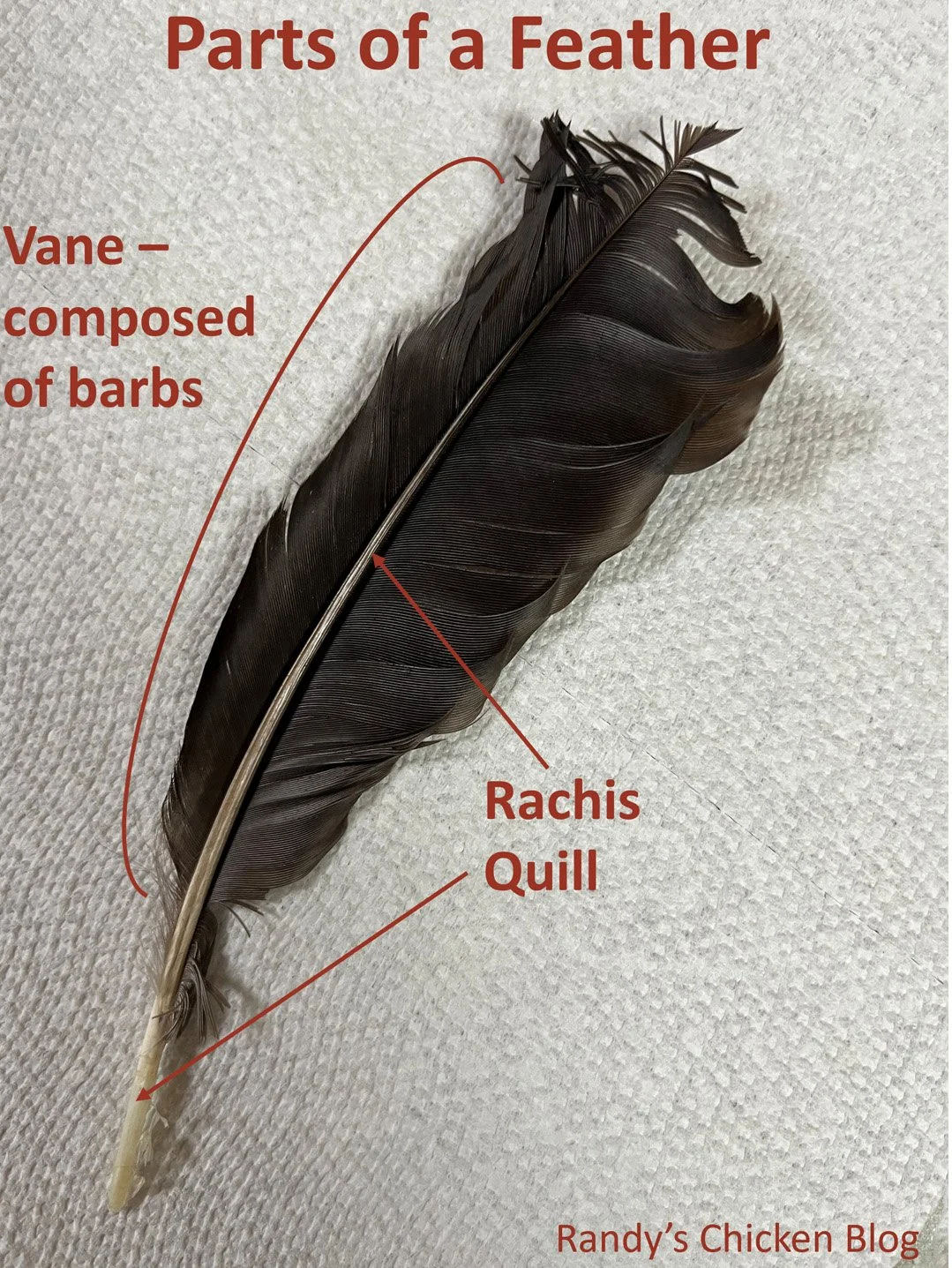

Those microscopic barbicels hook the barbules together, allowing the feather to hold its shape. Think of them as nature’s version of Velcro. Down feathers don’t have barbicels, so their barbules can float freely. That gives down its characteristic fluffiness and creates tiny pockets of air that provide excellent insulation. Silkie chickens take the “fluffiness” concept one step further: All of their feathers lack barbicels, which is why Silkies look so adorably fluffy!
All of this elaborate engineering serves a very important purpose. Without these intricately designed feathers, birds could not fly. Depending on the bird species, feathers can also provide insulation, help repel water, and provide camouflage. And once a year, during the molt, each feather follicle in every chicken produces one of these amazingly complex structures all over again.
Feather molting is commonly thought of as a two-step process: first the old feathers fall out, and then new ones grow in to replace them. It seems logical enough—out with the old, in with the new. But that’s not how it works. The process actually is exactly opposite of that. The new feather begins growing first, and as it develops, it pushes the old feather out of the follicle. So those old feathers aren’t simply falling out on their own. They’re being evicted by their replacements.
The newly forming feather grows inside a keratin sheath. As the feather develops, this sheath grows out of the follicle and emerges above the skin. Because these growing structures look like little pins, they’re called pin feathers.
Pin feathers have a blood supply that delivers nutrients to the developing feather. When a young pin feather is full of blood, it may be called a blood feather. And because it contains blood vessels, damaging one can result in surprisingly heavy bleeding.
As the feather continues to grow, the tip of the pin feather becomes opaque and white. Blood has receded from the tip, and air is now present inside the sheath and around the developing rachis and barbs. Even though the base of the feather still has a blood supply, the tip is no longer a “blood feather.” At this stage, plain old pin feather is the more accurate term.
Eventually, the chicken takes over. During preening, she removes the dried keratin sheath, revealing the shiny new feather underneath—and filling the coop with keratin sheath dust. The feather expands into its finished form, and the chicken’s new fall wardrobe is ready for modeling and display.
The chicken then wears that shiny new plumage for the next year. When fall rolls around again, the next generation of feathers begins growing and pushes those year-old, increasingly worn and battered feathers out of their follicles. And the whole process starts all over again.
If a feather is accidentally plucked or lost before its scheduled molt, the follicle doesn’t necessarily wait around for fall. Within a couple of weeks, it can begin producing a replacement feather. Chickens, apparently, understand the idea of having a change of clothes on hand for emergencies.
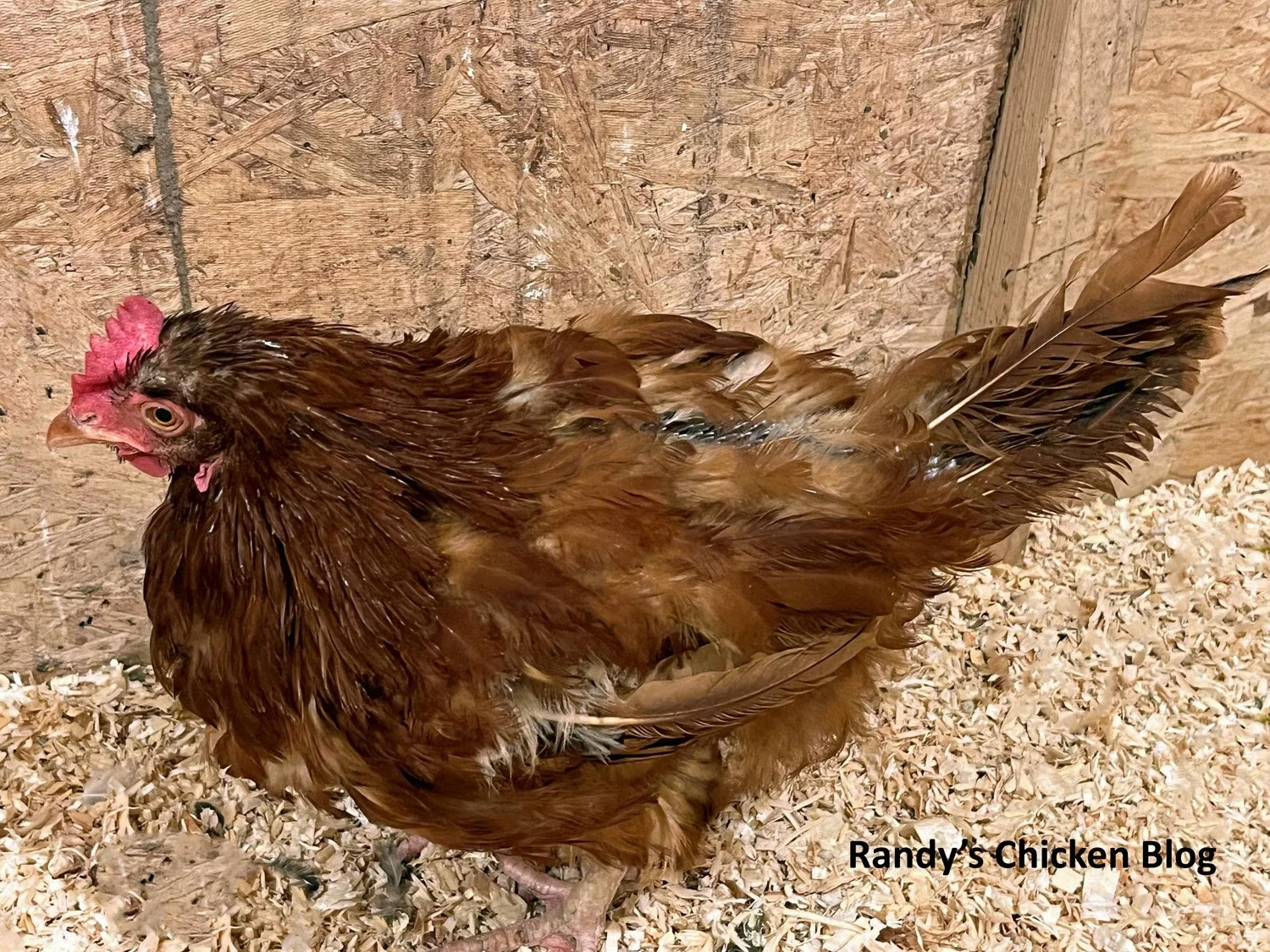
Roz the Rhode Island Red Molts
Give Your Molting Hens a Helping Hand - Three Ways
Increase Dietary Protein
Since those new feathers your birds are growing are made almost entirely of protein, increasing the protein in their diet is probably the most important thing you can do for your flock. Normal balanced layer feed is usually around 16% protein. During a molt, consider increasing that to 18–20% by switching to a higher-protein feed and offering some high-protein treats.
When changing feeds, make the switch gradually by mixing increasing amounts of the new feed into the old over the course of about a week. There is commercial chicken feed specifically formulated for molting chickens, but any chicken feed with an 18-20% protein content, like a grower feed or an unmedicated starter, will work just fine.
This is also a good time to lay off the scratch for a while and substitute some high-protein treats. Sunflower seeds are about 15% protein. Cooked eggs are a wonderful source of protein, although they may be a little impractical since your egg supply has probably dwindled to approximately zero while your flock is molting.
Black soldier fly larvae are another excellent option, containing roughly 32% protein. Chickens love them—insects, after all, are a natural part of the diet of free-ranging chickens.
One word of caution about these delicious and nutritious little treats: A July 2025 paper published in Poultry Science found that Chinese-sourced black soldier fly larvae contained, on average, 25 times more lead and 8 times more arsenic than North American-produced larvae. Until that problem is resolved, I’d avoid BSFL produced in China.
Another high-protein snack option is cooked meat or fish. Your chickens won’t complain. In fact, they may decide you are finally doing your job properly.
And don’t forget the oyster shell. Continue offering it free-choice, or provide some other source of calcium. Your hens may not need much calcium for eggshell production while they’re molting, but they still need calcium for normal body functions and to replenish calcium stores in their bones- depleted after months of producing eggs.
Reduce Stress
Molting is a stressful time for your flock, so adding more layers of stress is counterproductive. If you bought new chicks in the spring, the timing can sometimes work out so that they reach the age when they should be incorporated into the flock just as the older hens are beginning their molt.
Introducing young pullets to an established flock is already a high-stress event. Don’t pile a molt on top of it. Try to get the introductions underway well before the molt begins. If that isn’t possible, wait until the molt is nearly finished.
For the same reason, don’t introduce new adult birds during the molt, and don’t move your flock into new quarters. Your chickens have enough going on without adding a new address to the list.
This is also a good time to spend a little extra time in the coop keeping an eye out for bullying--molting hens can be particularly vulnerable. Watch for feather pecking, too. Those new pinfeathers are filled with blood and can become tempting targets for other chickens. If a hen becomes a target, isolate her immediately.
And then there are all those feathers lying around the coop. You may feel an overwhelming urge to conduct a major coop cleaning operation. Don’t! Your hens don’t mind walking through a few piles of feathers, and excessively fastidious coop cleaning just adds unnecessary stress during an already stressful time. This is one of those situations when doing less is actually doing better. Let the feathers accumulate for a while. You’ll have plenty of opportunities to clean them up later.
Avoid Handling
Imagine having a bazillion little needles sticking out of your skin. How much would you like to be touched? Exactly. That’s how your hens feel about it when they’re molting. Not only are pinfeathers tender, but they are filled with blood and vulnerable to breaking and bleeding.
You may feel bad for your hens with their bare patches of skin, protruding pins and ragged appearance. But this is not the time to show your sympathy and affection with big hugs. Leave those girls alone!
Skip nail and spur trimming, minor bumblefoot procedures, or anything else that involves unnecessary handling until the hen’s feathers have grown back. There is one important exception: If a hen has a pinfeather that is broken and bleeding, deal with it. Wipe away the blood with a damp cloth and apply gentle pressure to the broken feather with some styptic powder on a clean cloth or piece of gauze. If the bleeding continues or other hens are attracted to the blood, isolate her.
And then there are those folks who think chicken sweaters are a good idea, especially when their hens are missing half their feathers. I have said a few words about chicken sweaters before. Chicken sweaters are never a good idea! Especially during a molt! Because no handling!
Let Them Molt
A molt may make your coop look like a catastrophe at a pillow factory, and the sudden drop in egg production can make you wonder if your hens have gone on strike. But molting is a perfectly normal and necessary part of a chicken’s life.
Your job is pretty simple: give them plenty of good-quality protein, keep stress to a minimum, pay attention to how they’re doing but resist the urge to fuss over them.
In a nutshell, feed them well, keep them happy, and nix on handling, hugs and sweaters!
Before long, those sad, raggedy hens will be sporting a brand-new set of feathers—and, eventually, will get back to the business of making eggs.